This is a drawing and color-planning exercise, not a tested brush-menu walkthrough. Adapt it to tools actually available in your session; it does not promise blending, opacity controls, or a score.
Start with one eyeshadow shape you can recognize
Decide whether the look should read as a rounded color area or a lifted outer shape. Build that large shape before decorating its edge. A complete simple eye is easier to review than several unfinished marks with no clear outline.
The diagram separates the main color from added outer depth. Its drawn eye is schematic: it does not show the Roblox interface, an available stamp, or an exact in-game result.
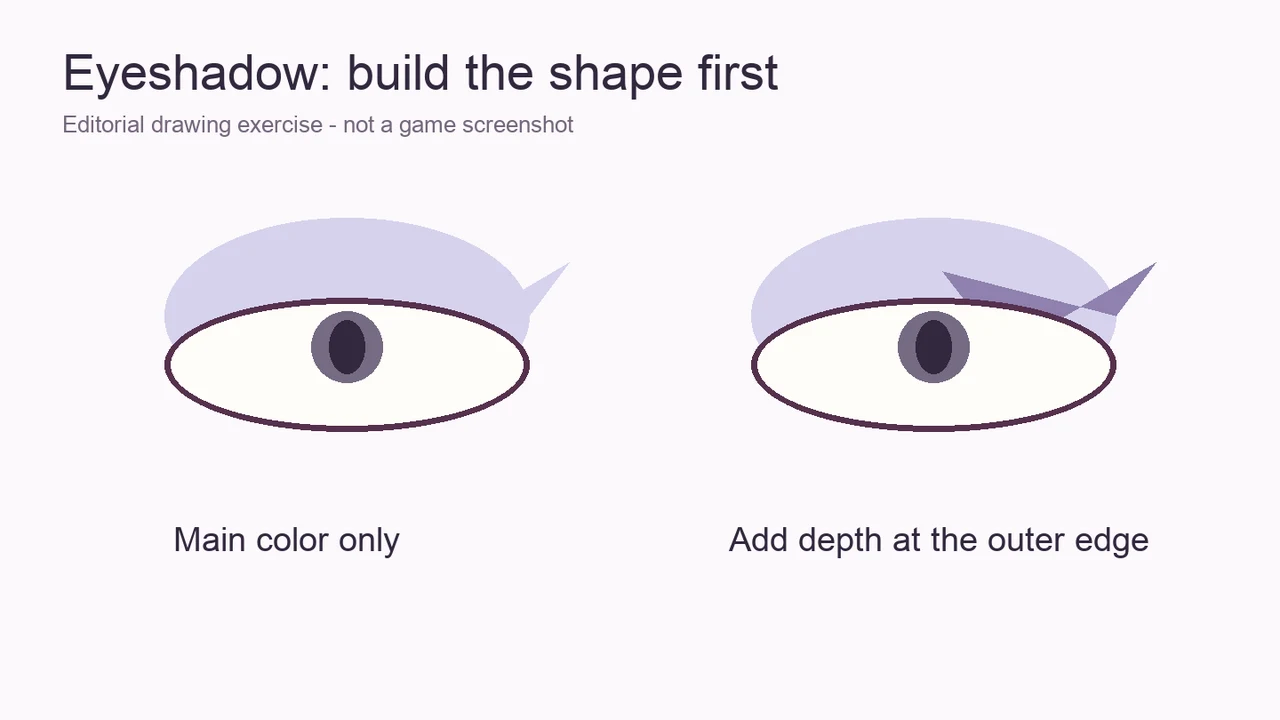
A three-step Makeup Mania eyeshadow plan
Use this sequence to assign each color a visible role. If your actual tools cannot produce a soft transition, keep the larger color blocks distinct instead of assuming an unavailable blending control.
- Lay out the main color area so the eye remains recognizable.
- Place a smaller depth shade toward the outer edge.
- Keep a light gap or highlight between the darkest makeup and dark hair.
Why does the eye still look flat?
Several similar shades can occupy different areas yet have nearly the same lightness. Move the depth shade into a smaller, clearly darker region, or choose a lighter main color so the two areas are easier to distinguish.
Review the face at the size used for your own comparison, wherever the interface permits. Do not automatically darken everything: a solid dark patch removes the separation you were trying to create. Change one region and compare before editing another.
Two worked color directions
For a Y2K-inspired direction, let icy blue lead and keep pink to a small accent. For a Goth-inspired direction, keep a pale highlight beside plum depth so the dark outer edge remains visible. These examples borrow this site’s editorial palettes, not a confirmed theme list.
You can use the color relationships without reproducing exact HEX values. Support for entering HEX text, applying shimmer, or using particular brushes has not been verified.
Finish shadow before strengthening the liner
An outline can help a finished shadow shape read, but it can also cover the color area if it becomes too wide. Check the border after the shadow has a main region, depth, and a light gap; keep whichever parts support that plan.
Use the liner guide if your correction has become a thick border. Keep hair from concealing the region you want to show, and treat votes as other players’ responses rather than proof of a hidden color rule.